Salzburg Easter Festival guide
How to plan a trip around the Salzburg Easter Festival — what it is, where it plays, how it differs from the summer Festival, and the hotel, restaurant and timing strategy for spring culture.

Photo: 1971markus / Wikimedia Commons · CC BY-SA 4.0
- ✓The Osterfestspiele Salzburg (Salzburg Easter Festival) is a short, intense, high-end festival of opera and orchestral concerts held over roughly ten days around Easter.
- ✓It was founded in 1967 by conductor Herbert von Karajan as a spring counterpart to the summer Salzburg Festival, with the Berlin Philharmonic as its original resident orchestra.
- ✓Performances centre on the Großes Festspielhaus and the wider Festspielhäuser quarter on Hofstallgasse — the same houses the summer Festival uses.
- ✓This is the connoisseur's festival: small in number of performances, premium in price and prestige, with a single staged opera at its heart each year.
- ✓Easter is a beautiful, far quieter time to be in Salzburg than high summer — but the festival itself rewrites hotel demand for its dates, so book ahead.
A jewel-box festival in the Salzburg spring
If the summer Salzburg Festival is the great public spectacle — six weeks of opera, drama and concerts that fill the whole city — the Easter Festival is its more private, more rarefied sibling. The Osterfestspiele Salzburg runs for only about ten days around Easter, with a handful of performances built around a single new opera production and a series of orchestral concerts. It draws a devoted international audience who come precisely for that concentration: a small number of nights, each treated as an event, in the magnificent acoustic of the Großes Festspielhaus. For a couple who love music, it makes an unusually elegant reason to be in Salzburg before the gardens have fully woken and the tour crowds have arrived.
Salzburg in spring is at its loveliest and least hurried. The Baroque squares are uncrowded, the Mirabell parterre is coming back into colour, the cafés have an unhurried feel, and the fortress sits clear above a city you can actually wander. Wrap a festival ticket or two around that, and you have one of the best-value cultural breaks the city offers — not in the price of the tickets, which are firmly premium, but in everything around them: calmer hotels than summer, easy restaurant tables, and a city that feels like it belongs to residents again. This guide explains what the festival is, how it differs from the famous summer one, where it plays, and how to plan the trip around it.

At a glance: the Easter Festival
A quick orientation. The festival's exact dates move with Easter each year and its programme is announced well in advance, so treat specifics as evergreen and verify the current edition on the official Osterfestspiele Salzburg website before you book.
- What: the Osterfestspiele Salzburg, a premium festival of opera and orchestral concerts.
- When: roughly ten days around Easter (the dates shift each year with the moveable feast) — verify the current edition.
- Founded: 1967, by Herbert von Karajan, as a spring complement to the summer Festival.
- Resident orchestra: historically the Berlin Philharmonic; the resident orchestra has changed over the festival's history, so check the current partner.
- Where: the Großes Festspielhaus and neighbouring houses on Hofstallgasse, in the Old Town under the Mönchsberg.
- Character: small in scale, high in prestige and price; one staged opera plus concerts each year.
- Tickets: limited and in demand — released months ahead; verify prices and on-sale dates with the festival.
What it is, and how Karajan created it
The Easter Festival exists because Herbert von Karajan wanted it to. As one of the dominant conductors of the twentieth century and a Salzburg native, Karajan founded the Osterfestspiele in 1967 to give his Berlin Philharmonic a stage of its own in his home city, outside the busy summer season. The model he built was deliberately exclusive: a single great opera production, mounted with the finest singers and the Berlin orchestra in the pit, plus a programme of symphonic concerts — all compressed into the Easter holiday and aimed at a self-selecting, high-paying audience. That founding DNA still shapes the festival today.
Over the decades the festival's resident orchestra and artistic leadership have changed, and its identity has evolved with them, but the essential shape has held: this is a short, opera-and-orchestra festival of the highest international rank, distinct from and complementary to the summer Festival. It is not a sprawling programme you dip in and out of; it is a small number of carefully staged nights. Because the offer is so concentrated, demand for the best performances is intense, and tickets for the flagship opera in particular go quickly when they are released. If a specific production is your reason for the trip, plan around its on-sale date rather than the other way around.
How it differs from the summer Salzburg Festival
Visitors often confuse the two, so it's worth being clear. The summer Salzburg Festival (the Salzburger Festspiele) runs from late July into the end of August: six weeks, dozens of opera, drama and concert performances, the open-air Jedermann on Domplatz, and the whole city given over to it. The Easter Festival is the opposite in scale — about ten days, a handful of performances, no drama programme of the same kind, and a single staged opera at its centre. Both use the same Festspielhäuser on Hofstallgasse, so the venues feel familiar, but the experience is entirely different in rhythm and crowd.
For trip planning, the practical contrasts matter. Summer means peak prices, packed hotels and a city at its busiest; Easter means a far quieter Salzburg with spring weather, easier restaurant tables and a calmer atmosphere — albeit with the festival's own dates pushing up hotel demand locally. If you want the grand, festive, all-encompassing Salzburg experience, summer is unmatched. If you want world-class opera in a beautiful, uncrowded city and you're happy to build a short trip around a couple of premium nights, Easter is the connoisseur's choice. For the full picture of the famous summer season, see our Salzburg Festival material on the events hub.

Where it plays: the Festspielhäuser quarter
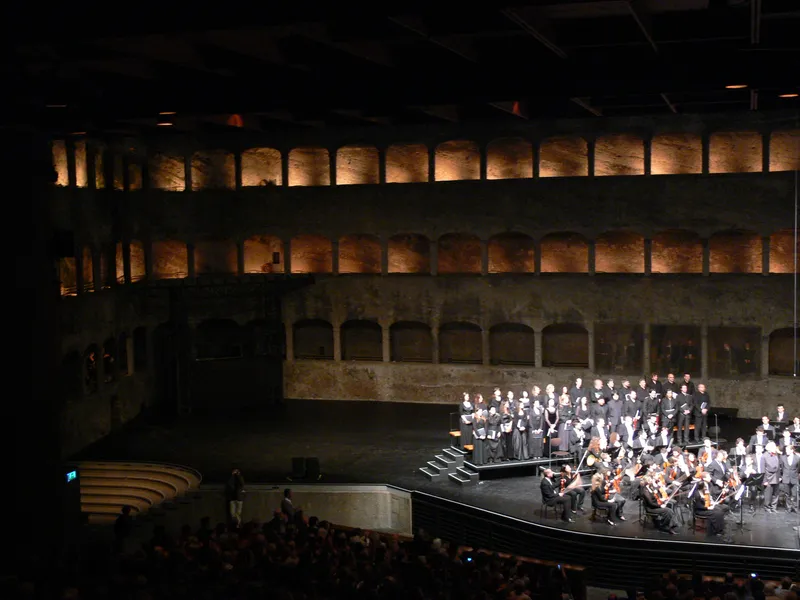
The heart of the Easter Festival is the Großes Festspielhaus, the large festival hall carved into the flank of the Mönchsberg on Hofstallgasse in the Old Town. This is one of the great opera and concert venues of Europe, built into the rock of the mountain, and the same house the summer Festival uses for its biggest productions. Around it on the same street sit the other festival houses (the Haus für Mozart and the Felsenreitschule, the old riding school cut into the cliff), which the festival may also use depending on the year's programme. Everything is within the historic centre, a short walk from the cathedral squares and the river.
Because the venues are right in the Altstadt, a festival evening folds naturally into the rest of a Salzburg trip: an afternoon among the squares and the fortress, an early dinner, then the short walk to Hofstallgasse for the performance. Dress is smart — this is a formal audience — and arrival is best unhurried, as the foyers are part of the occasion. For the specific seating, entrances and accessibility of each hall, see the festival venues guide, which covers the same Hofstallgasse houses in detail.

Tickets and planning the trip
Easter Festival tickets are limited, premium and sought-after, especially for the flagship opera. They are released months in advance through the official Osterfestspiele Salzburg box office, and the strongest performances can sell out quickly. The sensible approach is to decide which performance you want, watch for the programme announcement and on-sale date, and be ready to book when seats are released — rather than hoping for availability close to the dates. We don't quote prices here because they vary by year, production and seat category; check the official site for the current tariff and any package or hotel-inclusive options the festival offers.
Around the tickets, plan as you would for any in-demand cultural break. Book your hotel as soon as your performance is confirmed: the festival's dates concentrate demand even though spring is otherwise quiet, and the most convenient Old Town and Mirabell-side hotels go first. Allow time on either side of the performance to enjoy a calmer Salzburg — the gardens, the fortress, a Salzkammergut day trip if the weather is kind. And reserve any special dinner in advance; a pre-performance table near Hofstallgasse is a lovely touch, but the best restaurants fill on festival evenings.

The wider spring break around it
The real pleasure of an Easter Festival trip is everything the season gives you for free. Salzburg in late March and April is mild, fresh and quiet: the Mirabell Gardens are reawakening, the riverside walks along the Salzach are at their best, and the Old Town squares are walkable without the summer press of groups. A couple of premium opera or concert nights anchor the trip, and the days around them belong to the city — the fortress, the Mozart houses, a coffeehouse afternoon, perhaps a drive out to the lakes if the spring weather cooperates.
If Easter doesn't suit your calendar but a short, high-end spring festival appeals, the Whitsun Festival six weeks later offers a similar concentrated, prestige experience under different artistic leadership. Either way, use the by-month and spring guides to understand the weather and what's open, and treat all dates and prices as things to verify with the official sources before you commit. The festival's specifics change every year; the spring city around it is the reliable, romantic constant.
Related guides

Salzburg in March
Early spring in Salzburg — variable mountain weather, the Easter Festival in some years, quieter squares, lower hotel rates and indoor culture at its best.
Read guide
Salzburg in April
Salzburg's spring quickens — Easter in most years, gardens waking, Hellbrunn reopening for the season, shoulder-season value and the standing caution of mountain weather.
Read guide
Salzburg Festival Hotels
Where to stay for the Salzburg Festival — venue walking distance, intermission and late-dinner timing, luxury and budget picks, and the booking windows that decide whether you get a room at all.
Read guideMore in Events
6
Hellbrunn Advent Market guide
A guide to the Hellbrunn Advent Market at Schloss Hellbrunn — its fairy-tale palace setting, family features, how to get there on bus 25, and how to pair it with the city Christmas markets.
Read guide
Jazz & The City Salzburg
How to plan a trip around Jazz & The City — Salzburg's free autumn jazz festival that turns the whole Old Town into a stage for several October days, with the venues, timing, hotel and nightlife strategy to make the most of it.
Read guide
Mozart Week Salzburg guide
Plan Salzburg's winter Mozart festival — what Mozart Week (Mozartwoche) is, its January timing around the composer's birthday, the concerts and museums, and how to organise a cold-weather trip.
Read guide
New Year in Salzburg
How to spend New Year's Eve and New Year's Day in Salzburg — where to stay, where to dine, where to gather for the turn of the year, how to move around, and what's open and closed over the festive turn, with a romantic and practical plan for the trip.
Read guide
Rupertikirtag Salzburg
How to visit the Rupertikirtag — Salzburg's traditional autumn fair around the cathedral squares, held for the feast of the city's patron saint — with what to expect from the rides, food, beer and crowds, and how to time it.
Read guide
Salzburg Advent Singing
How to plan a visit to the Salzburger Adventsingen — the city's landmark Advent Singing — with what the event is, where it's staged, how it fits the Christmas markets and where to stay in December.
Read guide