Salzburg Old Town Guide
How to explore Salzburg's UNESCO Old Town — the Baroque squares, the cathedral and churches, Getreidegasse's lanes, the hidden courtyards, viewpoints and riverside walks.

Photo: Alex Hufnagl / Unsplash
- ✓The Altstadt is a UNESCO World Heritage Site, listed for its exceptionally preserved Baroque townscape and dramatic mountain setting.
- ✓Getreidegasse is the medieval canyon of wrought-iron guild signs, with Mozart's Birthplace at No. 9.
- ✓Domplatz, Residenzplatz and Mozartplatz form the ceremonial heart of the left bank.
- ✓Almost everything sits inside the loop of the Salzach, beneath the fortress — you'll keep crossing your own path.
- ✓The Durchhäuser, the pass-through houses, hide some of the city's most beautiful courtyards.
A Baroque stage you can cross on foot
Salzburg's Old Town is small, walkable and unusually intact — a tight grid of marble squares, church façades and shop-lined lanes laid out like a stage set, all of it folded into a bend of the Salzach beneath the Festungsberg. You can cross it in fifteen minutes, which is the point: the pleasure is wandering, looping back, and finding the same fountain from a new angle in different light.
The salt that gave the city its name paid for all of this. For a thousand years the prince-archbishops grew rich on white gold floated down the river, and that wealth, channelled by Italian-trained architects in the seventeenth century, built the harmonious Italian Baroque skyline you walk through today. UNESCO listed the Altstadt in 1996 for exactly this — a remarkably preserved historic townscape in a spectacular setting.
The three squares: Domplatz, Residenzplatz, Mozartplatz
The ceremonial heart of the left bank is a chain of three linked squares. Domplatz sits directly beneath the cathedral's west front and its dome, a broad paved space that becomes the open-air stage for the Festival's Jedermann each summer. Step north into Residenzplatz, the grandest of the three, anchored by an enormous Baroque marble fountain and framed by the Residenz palace and the New Residence with its Glockenspiel carillon, which chimes on a set daily schedule.
Mozartplatz, just east, is the most intimate of the trio, centred on the bronze statue of the composer unveiled in 1842. From these squares the whole Old Town radiates: the cathedral and DomQuartier to the south, Getreidegasse to the west, the river and its bridges to the north. Linger here at the edges of the day — early morning before the crowds, or the blue hour when the cafés glow.
The cathedral, the Residenz and DomQuartier
Salzburg Cathedral, the Dom, is the early-Baroque set piece — an Italian-influenced church of pale marble crowned by a soaring dome, consecrated in 1628 after fire destroyed its Romanesque predecessor. Mozart was baptised at its font and later worked here as court organist. Entry to the nave is generally free; deeper routes take in the crypt, the dome and the cathedral museum.
Around and behind it spreads the DomQuartier, a museum circuit that links the cathedral, the prince-archbishops' Residenz state rooms and the abbey of St. Peter under one ticket, letting you walk the corridors of power the rulers once used. The Residenz itself, with its lavish staterooms and gallery, is the secular counterweight to the city's churches — proof that Salzburg's archbishops were temporal princes as much as clerics.
St. Peter's, the Franciscan Church and the rock
A short walk from the cathedral, St. Peter's Abbey is the oldest monastery in the German-speaking world still in operation, founded in the seventh century. Its church wraps a Romanesque core in exuberant Rococo, and its churchyard — a quiet garden of wrought-iron grave markers backed by the cliff of the Mönchsberg — is one of the most atmospheric corners in the city. Cut into that cliff above are the catacombs, ancient chapels hewn from the rock with a view back over the graves.
Between St. Peter's and the cathedral stands the tall, slightly austere Franciscan Church, whose soaring Gothic choir and Baroque high altar make a striking contrast to the surrounding marble. Together these churches show the Old Town's two registers — grand ceremony and ancient hush — within a couple of minutes' walk of each other.
Viewpoints and the river edge
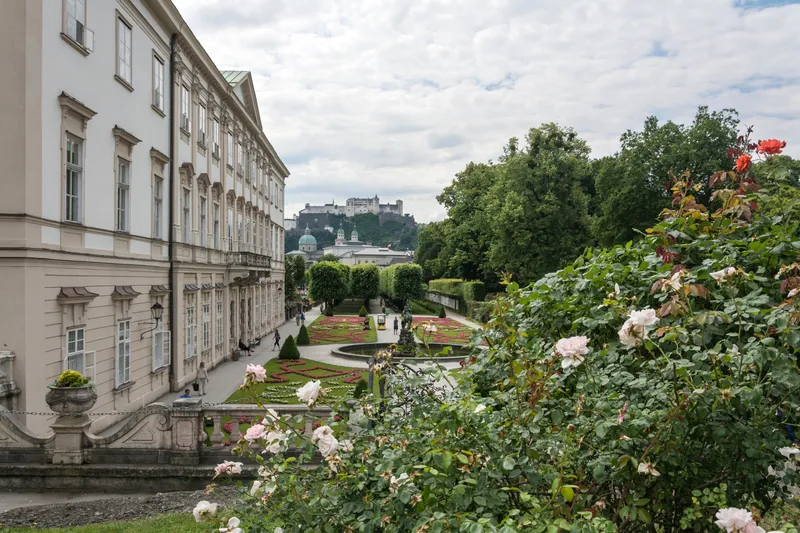
The Old Town is hemmed by heights, and using them is how you understand its shape. The fortress, reached by the Festungsbahn funicular or the cobbled climb, gives the definitive panorama; the Mönchsberg ridge, reached by the Mönchsberg lift, gives a quieter one with terraces and a museum café. Either turns the warren of lanes below into a legible Baroque plan.
Down at river level, the Salzach promenade runs the length of the Old Town, and the love-lock Makartsteg footbridge frames the fortress and the domes for the classic photograph. Crossing the river here also links the left-bank Altstadt to the right-bank Neustadt around Mirabell — the two halves of the historic city, a five-minute walk apart.

Practicalities: when to go and how to move
The Old Town is almost entirely pedestrian, so good shoes for cobbles and a few slopes matter more than anything else. Mornings before the day-trip coaches arrive, and evenings after they leave, are the quietest and most photogenic windows; midday in high summer and Advent is the busiest. The Salzburg Card bundles free entry to many of the museums and churches' deeper routes along with the funicular and lifts — worth doing the maths on if you plan several paid sights.
Because everything is so close, resist the urge to over-plan. Pick a cluster — the squares and cathedral, or Getreidegasse and the courtyards, or St. Peter's and the abbey — and let one lead to the next. The self-guided walk threads them into a single loop if you'd rather follow a route than improvise.

Related guides

Self-Guided Salzburg Old Town Walk
A step-by-step self-guided walking route linking Mirabell, the river views, Getreidegasse, the cathedral, St. Peter's and the climb to the fortress — done at an easy half-day pace.
Read guide
Things to Do in Salzburg
The complete hub for what to do in Salzburg — the fortress, Mozart sights, Mirabell, the Old Town squares, Sound of Music stops, viewpoints and Alpine day trips, grouped so you never backtrack.
Read guide
Hohensalzburg Fortress Guide
A practical guide to Hohensalzburg Fortress — tickets, the Festungsbahn funicular, the state rooms and museums, the best viewpoints, timing and Salzburg Card notes for the hilltop castle.
Read guideMore in Things to Do
6
Best Museums in Salzburg
Choose Salzburg museums by interest, weather, Mozart focus, family fit and Salzburg Card value.
Read guide
Best Photo Spots in Salzburg
Fortress views, Mirabell, Old Town lanes, river bridges, Mönchsberg, blue hour and Christmas lights.
Read guide
Best Salzburg Tours
When to book walking, Mozart, Sound of Music, food, fortress, bike and day-trip tours — and when to skip a tour and just wander.
Read guide
Best Things to Do in Salzburg
A ranked first-trip shortlist of the best things to do in Salzburg — what to book, what is free, and how to group the city so you never backtrack.
Read guide
Best Viewpoints in Salzburg
Fortress, Mönchsberg, Kapuzinerberg, Humboldtterrasse, Untersberg, rooftops and river views ranked by effort.
Read guide
Best Walking Tours in Salzburg
Which Salzburg walking tour fits your time, interests, mobility, music focus and budget — from free group walks to private guides.
Read guide