Self-Guided Salzburg Old Town Walk
A step-by-step self-guided walking route linking Mirabell, the river views, Getreidegasse, the cathedral, St. Peter's and the climb to the fortress — done at an easy half-day pace.

Photo: Andrew Bossi / Wikimedia Commons · CC BY-SA 2.5
- ✓A loop of roughly two to three hours at a sightseeing pace, easily stretched to a half-day with stops.
- ✓Starts at Mirabell on the right bank, crosses the Makartsteg, and climbs to the fortress at the end.
- ✓Almost entirely flat until the final fortress climb — which you can swap for the funicular.
- ✓Free to walk; only the museums, churches' deeper routes and the funicular cost anything.
- ✓Best done early morning or late afternoon to dodge the day-trip crowds.
Before you start: the shape of the walk
This route threads the essential Old Town in a single, sensible loop, so you see the highlights in a logical order without doubling back. It begins on the right bank at Mirabell, where parking and the station are close, crosses the river by the love-lock Makartsteg footbridge into the heart of the Altstadt, works through Getreidegasse, the squares and the churches, and finishes with the climb — or funicular ride — up to the fortress for the view that ties the whole city together.
Allow two to three hours at a walking-and-looking pace, or a relaxed half-day if you stop for coffee, go inside the cathedral and the museums, and ride up to the fortress. The terrain is flat and paved almost the whole way; only the final ascent to the Festung is steep, and you can replace that with the Festungsbahn. Wear shoes that cope with cobbles, and aim for early morning or late afternoon, when the lanes are quietest and the light is best.

Step 1 — Mirabell Gardens and the fortress view
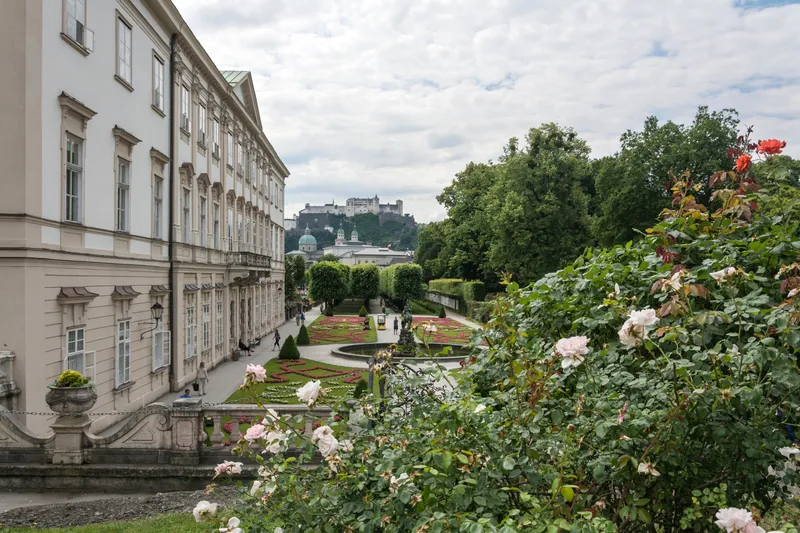
Begin in Mirabell Gardens on the right bank. Stand at the top of the terraced steps near the Pegasus Fountain and look south: the formal Baroque parterre lines up its central axis straight across the river at Hohensalzburg, giving you the city's signature view and a preview of where the walk ends. Sound of Music fans will recognise the steps and the fountain from 'Do-Re-Mi'. The garden is free and best at opening time, before the tour groups.
Walk down through the parterre, past the clipped hedges and mythological statues, toward the river. If the palace is open, glance into the courtyard for the Marble Hall, the former ballroom that now hosts evening concerts. Then head for the riverbank.
Step 2 — Cross the Makartsteg into the Altstadt
From Mirabell, walk a couple of minutes to the Makartsteg, the pedestrian bridge hung with thousands of love-locks. Pause mid-span: this is the classic river photograph, with the fortress, the cathedral dome and the Old Town rooftops all lined up downstream. The Salzach below is the river that floated the salt that built everything you are looking at.
Cross to the left bank and you are in the Altstadt proper. Bear left along the riverside lane and into the network of passageways behind Getreidegasse — or carry straight on toward Universitätsplatz, where the Saturday Grünmarkt and the curving Baroque Kollegienkirche set the tone.

Step 3 — Getreidegasse and the courtyards
Make your way to Getreidegasse, the medieval shopping canyon roofed by a forest of wrought-iron guild signs. Walk its length once for the street itself, then double the pleasure by slipping through the Durchhäuser — the pass-through houses whose arched passages and hidden courtyards link the lane to the river and to Universitätsplatz. These quiet, café-lined courtyards are the part most visitors miss.
At No. 9, the bright yellow house, stop at Mozart's Birthplace, where the composer was born in 1756; the museum has run there since 1880. Whether or not you go inside, it anchors the street's story. From the eastern end of Getreidegasse you spill out toward the squares.
Step 4 — The three squares and the cathedral
You now reach the ceremonial heart: Residenzplatz first, with its huge Baroque fountain, the Residenz palace on one side and the New Residence's Glockenspiel carillon on the other. Step through to Domplatz, framed directly beneath the cathedral's marble west front and dome — the open-air stage for the Festival's Jedermann each summer — and on to the smaller Mozartplatz with the composer's 1842 statue.
Go inside Salzburg Cathedral, the early-Baroque Dom where Mozart was baptised and later played the organ; the nave is generally free to enter. If you want to go deeper, the DomQuartier circuit links the cathedral, the Residenz staterooms and St. Peter's under one ticket. Otherwise, carry on south toward the abbey.
Step 5 — St. Peter's churchyard and the rock
A minute's walk brings you to St. Peter's Abbey, the oldest monastery in the German-speaking world still in use. Wander into its churchyard — a hushed garden of wrought-iron grave markers backed by the sheer cliff of the Mönchsberg — and, if you have time, climb to the catacombs cut into the rock for a view back over the graves. The Romanesque-meets-Rococo church and the abbey's ancient bakery and restaurant make this the most contemplative corner of the walk.
This is also a natural lunch point: St. Peter Stiftskulinarium, set against the rock, claims to be one of the oldest restaurants in Central Europe, and the abbey's courtyard cafés are quieter than the squares. Rest here before the final climb.
Step 6 — Up to the fortress to finish
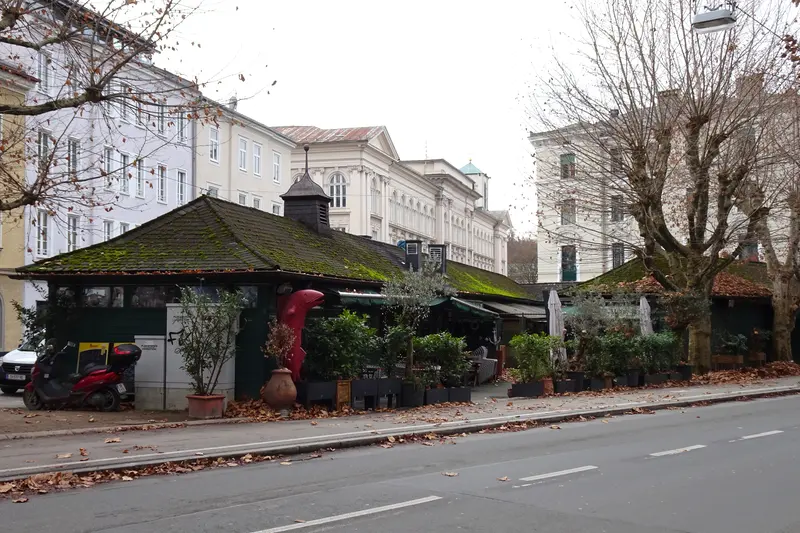
End where the city is best understood: at the top. From the cathedral district, follow Festungsgasse to the foot of the Festungsberg, where you choose your ascent. Walk the steep cobbled path for free, or ride the Festungsbahn funicular up in a minute or two — check whether your Salzburg Card covers it before buying. At the top, the Reckturm watchtower and the ramparts deliver the panorama over the domes, the river, the Mirabell gardens where you started, and the Untersberg massif beyond.
Take your time with the state rooms and the fortress museums, then descend the way you came. Back at river level you can close the loop across the Makartsteg, returning to Mirabell with the whole Old Town now mapped in your head — a half-day that has shown you the essential Salzburg on foot.
Related guides

Salzburg Old Town Guide
How to explore Salzburg's UNESCO Old Town — the Baroque squares, the cathedral and churches, Getreidegasse's lanes, the hidden courtyards, viewpoints and riverside walks.
Read guide
Hohensalzburg Fortress Guide
A practical guide to Hohensalzburg Fortress — tickets, the Festungsbahn funicular, the state rooms and museums, the best viewpoints, timing and Salzburg Card notes for the hilltop castle.
Read guide
Mirabell Palace and Gardens Guide
Visit Mirabell Gardens and Palace — the Baroque parterre, Pegasus Fountain, the Sound of Music steps, the Marble Hall and the best time of day to go.
Read guideMore in Things to Do
6
Best Museums in Salzburg
Choose Salzburg museums by interest, weather, Mozart focus, family fit and Salzburg Card value.
Read guide
Best Photo Spots in Salzburg
Fortress views, Mirabell, Old Town lanes, river bridges, Mönchsberg, blue hour and Christmas lights.
Read guide
Best Salzburg Tours
When to book walking, Mozart, Sound of Music, food, fortress, bike and day-trip tours — and when to skip a tour and just wander.
Read guide
Best Things to Do in Salzburg
A ranked first-trip shortlist of the best things to do in Salzburg — what to book, what is free, and how to group the city so you never backtrack.
Read guide
Best Viewpoints in Salzburg
Fortress, Mönchsberg, Kapuzinerberg, Humboldtterrasse, Untersberg, rooftops and river views ranked by effort.
Read guide
Best Walking Tours in Salzburg
Which Salzburg walking tour fits your time, interests, mobility, music focus and budget — from free group walks to private guides.
Read guide