Salzburg for First-Timers: An Easy Itinerary
The easiest first route through Salzburg, with booking priorities, the Salzburg Card decision, an Old Town flow that never backtracks, and day-trip timing.

Photo: Free Walking Tour Salzburg / Unsplash · Unsplash License
- ✓Group by bank: do the whole left-bank cluster (squares, cathedral, St. Peter's, fortress) in one block, the right bank (Mirabell, Mozart Residence) in another, and you'll never cross the river twice for nothing.
- ✓The Salzburg Card pays off only if you'll visit several paid sights and use the funicular and lifts — do the maths before you buy.
- ✓Book Festival tickets and summer concerts ahead; the fortress, museums and Mozart houses are usually fine to buy on the day outside peak hours.
- ✓Two unhurried days cover the essentials; a third lets you reach Hallstatt, the Salzkammergut lakes or the salt mines.
- ✓Most of the city is walkable over cobbles — comfortable shoes and a packed layer matter more than any ticket.
How to read this itinerary
This is the route we'd hand a first-time visitor: the easiest, most logical way to see Salzburg without backtracking, overpaying or missing the things you'd regret skipping. It is built for a first trip of two full days, with a third-day add-on for those who can stay longer. Everything here sits inside or just beside the UNESCO Old Town, which fits neatly inside a loop of the Salzach river, so the whole plan is walkable — the only times you'll need transport are for the lakes or salt mines on day three.
Treat it as a menu, not a march. The single biggest mistake first-timers make is criss-crossing the river all day; the fix is to group by bank, doing the left-bank sights in one continuous block and the right-bank sights in another. We'll walk through the booking priorities and the Salzburg Card decision first — the two things worth getting right before you arrive — then the day-by-day flow, then the practicalities. Salzburg is compact enough to plan tightly without ever feeling rushed.

At a glance
A quick orientation before the detail. Use it to sketch the trip, then read on.
- Ideal length: two full days for the essentials, three if you want a lake or salt-mine day.
- Where to stay: in or beside the Altstadt for atmosphere, or around Mirabell or the station for a calmer, flatter, rail-linked base.
- Getting around: on foot almost entirely; the Festungsbahn funicular and Mönchsberg lift cover the climbs.
- Book before you go: Festival tickets (late July–August), summer concerts, and your hotel in peak windows.
- Two tickets to understand: the Salzburg Card (sightseeing admissions) and the Guest Mobility Ticket overnight guests receive for regional transport. Verify current terms.
- Pace: gentle. Two or three headline sights a day, with squares, cafés and river walks between them.
Before you go: what to book, and what not to
Salzburg needs less advance booking than its fame suggests, but a few things reward it. If your trip lands during the Salzburg Festival — opera, drama and orchestral concerts across the Festspielhäuser in late July and August — tickets sell out and should be secured the moment they go on sale; this is also the window when hotels fill earliest and price up sharply. The Advent markets from mid-November bring a second hotel peak. Outside those windows you can be far more relaxed.
For most sights, buying on the day is fine outside peak hours: the fortress, the museums, the two Mozart houses and the cathedral all absorb walk-up visitors. The one thing worth reserving for any trip is an evening concert — fortress, Mirabell or St. Peter's dinner concert — which fills up in summer and makes an easy set piece. Equally useful is knowing what to skip: you don't need a paid guided tour of the Old Town if you'll happily wander, and you shouldn't buy a separate funicular ticket if your Salzburg Card already includes it.


The Salzburg Card decision
The Salzburg Card is the one purchase first-timers most often get wrong. It is a sightseeing product, sold in 24-, 48- and 72-hour versions, that bundles one-time free admission to a long list of sights — including the fortress and its funicular, the Mönchsberg lift, the Mozart houses, the DomQuartier, Hellbrunn and more — plus use of city public transport for the validity period. It is genuinely excellent value if you'll pack several paid attractions into consecutive days and use the funicular and lifts.
But it is a waste if your ideal Salzburg is mostly free squares, gardens, river walks and coffeehouse afternoons — none of which need a card. The honest test is to list the paid sights you actually want, add up their separate admissions, and compare with the card price for your length of stay; verify current prices on the official source rather than trusting a round number. For a typical two-day first trip that climbs the fortress, visits a Mozart house and the DomQuartier, and rides the Mönchsberg lift, the card usually pays for itself — but check the maths against your own list.

Day 1, morning — Getreidegasse and the Mozart story
Start your first morning early, while the Old Town is cool and quiet. Walk Getreidegasse before the shops open — the narrow lane roofed by a forest of ornate wrought-iron guild signs is at its most photogenic empty — and slip through the Durchhäuser, the pass-through houses, into the hidden courtyards behind the shopfronts, some of the loveliest corners in the city. At No. 9, the bright yellow house, Mozart was born in 1756 and the family lived for years; the Birthplace museum has welcomed visitors since 1880 and is the more atmospheric of the two Mozart houses, with original instruments and family portraits.
This is a gentle, orienting first morning rather than a sprint. Let the lane lead you east toward the squares, pausing for a first coffee. If you're a serious Mozart fan, you'll return to the second house — the Mozart Residence on Makartplatz across the river — on day two; the Birthplace alone is plenty for the morning. By late morning you'll have your bearings and be standing at the foot of the cathedral, ready for the ceremonial heart of the left bank.

Day 1, midday — the squares, cathedral and St. Peter's
The ceremonial heart of the Altstadt is a chain of three linked squares you can stroll in minutes: Domplatz under the cathedral dome, the grander Residenzplatz with its huge Baroque fountain and the Glockenspiel carillon, and Mozartplatz with the composer's statue. This is the open-air stage where the Festival's Jedermann is performed each summer. There's no ticket and no rush — the squares are simply there to be crossed, ideally more than once.
Salzburg Cathedral (the Dom) is the early-Baroque centrepiece where Mozart was baptised and later played the organ; the nave is generally free to enter, while the DomQuartier route links the cathedral, the Residenz state rooms and the connected galleries for a deeper visit. A few steps away, St. Peter's Abbey is older and quieter, with its famous wrought-iron churchyard and catacombs cut into the Mönchsberg cliff above. Break for lunch here: St. Peter Stiftskulinarium, set against the rock, claims to be one of the oldest restaurants in Central Europe.


Day 1, afternoon — climb the fortress
Finish the first day high. Ride the Festungsbahn funicular from Festungsgasse up to Hohensalzburg Fortress — one of the largest fully preserved castles in Central Europe, begun in 1077 and, famously, never taken by siege, which is precisely why the medieval and Baroque city below it stayed intact. Give it a couple of hours for the gilded late-Gothic state rooms, the fortress museums and, above all, the Reckturm watchtower, where the panorama over the domes, the river and the Untersberg is the photo you came to Salzburg for.
Going up at the end of the afternoon means softer light and thinner crowds than the mid-morning coach crush. If your knees are willing and the weather is kind, you can walk down the cobbled path for free instead of taking the funicular back. Whichever way, you'll arrive back in the Old Town in time for an aperitif as the floodlights come on — a fine end to a full first day that never once crossed the river.


Day 1, evening — a first dinner
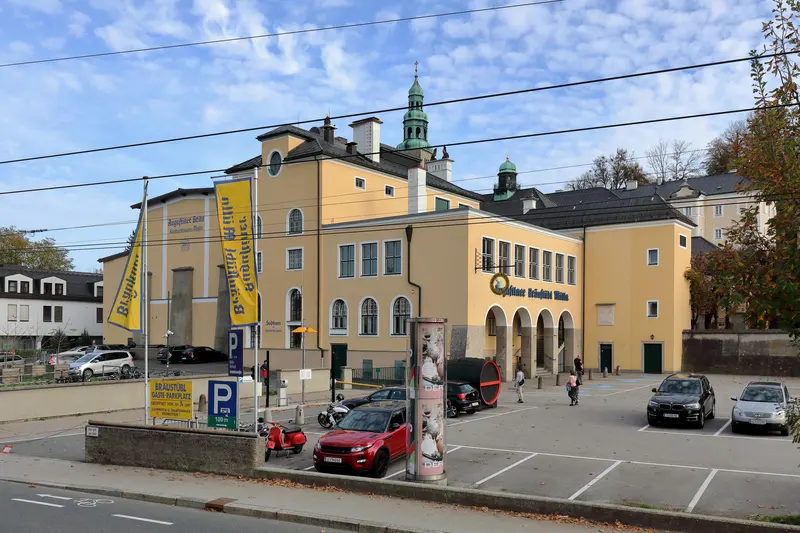
Keep the first night relaxed and local. A beer-hall dinner is the easy, authentic choice: the Augustiner Bräustübl in Mülln pours beer straight from wooden barrels under chestnut trees, a short walk or bus from the centre, with hearty food from the stalls in its halls. If you'd rather stay central, the Old Town has plenty of trout-and-schnitzel taverns and cosy cellars.
Whatever you eat, share a Salzburger Nockerl for pudding at least once on the trip — the billowing soufflé shaped like the city's three hills is enormous and meant for the table, not one person. Then walk the river back to your hotel; the Makartsteg footbridge, hung with love-locks, frames the floodlit fortress for the classic night photo.
Day 2, morning — Mirabell at opening time
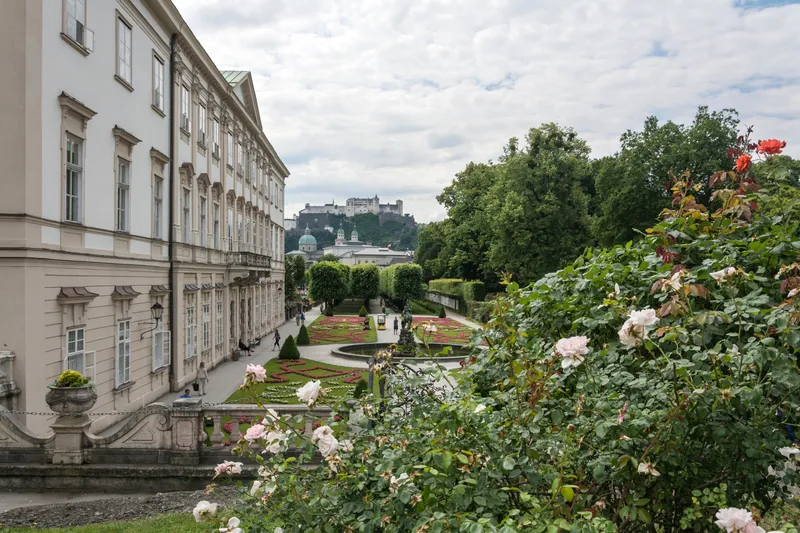
Cross the river early on day two for the right bank's set piece. Mirabell Gardens is free, open and beautiful, its central axis lined up so it points straight across the water at the fortress — the city's most photographed view. The trick is timing: arrive right at opening and you can have the parterre almost to yourself, the light soft and the tour groups still on their coaches. Sound of Music fans will recognise the Pegasus Fountain and the terraced steps from 'Do-Re-Mi'.
From the garden it's a short walk to the Mozart Residence on Makartplatz, the family's later, larger home and the second of the city's two Mozart museums — worth it for fans who want the fuller story, skippable for everyone else. A slow coffee at one of the Neustadt cafés rounds off the morning. This is also the moment to follow the in-city Sound of Music stops if that's your thing, since several cluster on this side of the river.

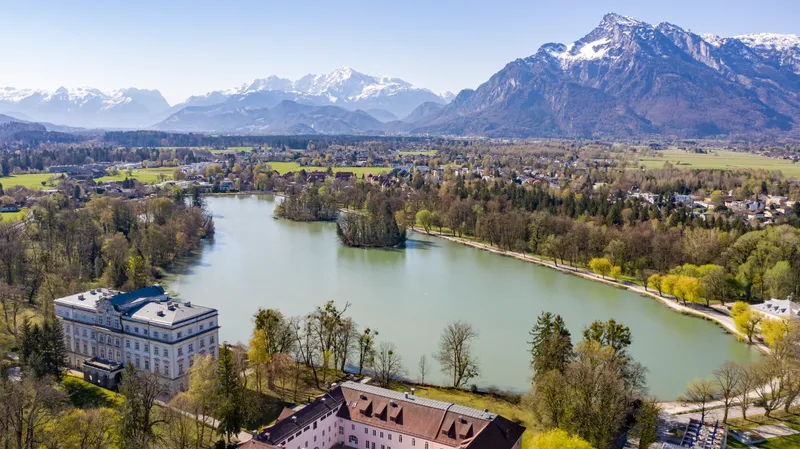
Day 2, afternoon — the heights and the river
For a view without the fortress queues, ride the Mönchsberg lift up beside the Museum der Moderne and walk the panorama path along the wooded ridge — one of the most underused pleasures in the city, with the whole Baroque skyline at your feet and a terrace café for a coffee with the best seat in Salzburg. It's a quieter, gentler high than yesterday's fortress, and an easy way to fill the afternoon.
Back at river level, the Salzach promenades make for a level, easy stroll, and the Linzergasse on the right bank is a relaxed lane for browsing away from the Getreidegasse crowds. If you have energy, the climb up the Kapuzinerberg gives a quieter view over the rooftops. Keep the afternoon loose — day two is meant to feel slower than day one, leaving room for whatever caught your eye yesterday.

Day 2, evening — a concert to finish
Make your second evening the trip's set piece with a concert. In the city that thinks in music, the three classic formats differ mostly by setting: a fortress concert pairs Mozart and Haydn with a candlelit hall and a funicular ride up after dark; a Mirabell concert uses the jewel-box Marble Hall, once a prince-archbishop's ballroom; a St. Peter's dinner concert weaves a meal through the programme in the abbey restaurant against the cliff. All run year-round and reward booking ahead.
Build dinner around your choice. If you've gone for the dinner-concert format the meal is sorted; otherwise the Old Town has tables for every mood, from grand to candlelit. It's a fitting way to close a first trip — the music that defines Salzburg, heard in one of the rooms that made it famous.

Day 3 (optional) — a lake or the salt mines
With a third day, leave the city. Salzburg sits at the edge of the Salzkammergut, where the old salt road met the Alps, so a day trip can be as memorable as the city itself. Hallstatt is the headline — a lake village of impossible postcards, reachable by train and boat — while the closer lakes (Wolfgangsee, Mondsee, St. Gilgen) reward a slower loop. Over the German border lie the Eagle's Nest, Berchtesgaden and the emerald Königssee.
If you'd rather understand the white gold that built the city, the Hallein salt mines just south make a fun, family-friendly half-day, and the Werfen ice caves with the dramatic Hohenwerfen fortress are Alpine theatre. Most are doable by public transport, though some are easiest by organised tour. Whichever you pick, give it a whole day rather than cramming it into a morning, and check return times against your onward travel.

Practical notes for a first trip
Two ticket products bear repeating because first-timers conflate them. The Salzburg Card is a sightseeing product (admissions plus city transport); the Guest Mobility Ticket is the regional public-transport ticket overnight guests generally receive from their accommodation. They are not the same thing — verify current terms for both when you book, rather than relying on figures that may have changed.
Beyond that, the logistics are simple. Salzburg's main station is a short walk or bus from the centre, and the airport is close on the west side. Pack a layer even in summer — this is an Alpine city with warm afternoons and cooler evenings — and wear shoes that handle cobbles, since you'll be on foot most of the trip. Time your visit with open eyes: the Festival fortnight and the Advent markets are magical but crowded and pricey, while spring and early autumn give you the same city at a calmer, cheaper pace.
Related guides

Best Things to Do in Salzburg
A ranked first-trip shortlist of the best things to do in Salzburg — what to book, what is free, and how to group the city so you never backtrack.
Read guide
Is the Salzburg Card Worth It?
When the Salzburg Card saves money and when it doesn't — how the 24, 48 and 72-hour options work, what's included, and how to do the quick maths before you buy.
Read guide
Where to Stay in Salzburg
Decisive, area-by-area advice on where to sleep in Salzburg — the Altstadt, Mirabell and the Neustadt, the station area, quiet Nonntal and Riedenburg, and lakeside Leopoldskron — for first-timers, couples, families, budget travellers, Festival nights and the Christmas markets.
Read guideMore in Itineraries
6
A Weekend in Salzburg
A Friday-to-Sunday plan for Salzburg with hotel-area logic, concert timing, the best viewpoints, where to eat and a soft day-trip choice for Sunday.
Read guide
Four Days in Salzburg
A slower four-day Salzburg plan that adds museums, quieter neighbourhoods, a Sound of Music morning and two day-trip options to the classic city core — paced for travellers who want to live in the city rather than sprint through it.
Read guide
Luxury Salzburg Itinerary
A high-end three-day Salzburg plan built around grand hotels, private guides, fine dining, a chauffeured lake day and concert nights — the city at its most unhurried and elegant, with everything booked ahead.
Read guide
Mozart & Music Itinerary
A music-led day through Salzburg — both Mozart houses, the cathedral and abbey where he played, the Mozarteum and Marionette Theater, and an evening concert chosen by setting, not just programme.
Read guide
One Day in Salzburg
A realistic, walkable one-day route through Salzburg — the Old Town squares, the fortress, a Mozart sight, Getreidegasse and Mirabell at golden hour — paced so you actually enjoy it rather than sprint.
Read guide
Salzburg Christmas Market Itinerary
A festive Salzburg plan for the Advent season — the Christkindlmarkt on the cathedral squares, smaller side markets, Advent music, warm coffeehouses, a candlelit Hellbrunn evening and the best floodlit viewpoints.
Read guide